🚩 Decision Governance for AI Agents Requires ARBITRATION.
Giving AI agents instructions, permissions, policies, and monitoring their behavior is not enough.
Governance must be able to intervene in how decisions are made and which actions are executed.
That requires ARBITRATION at runtime.
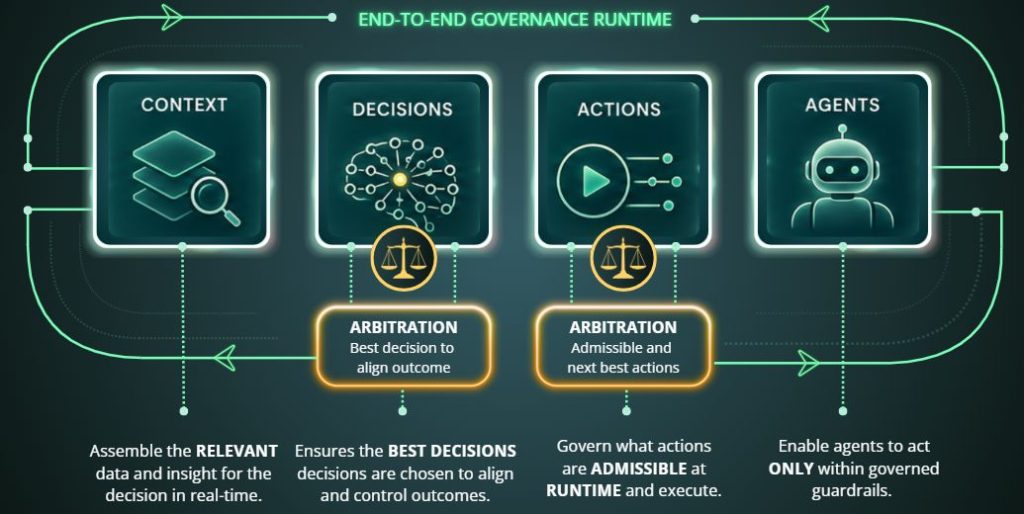
🔹 CONTEXT: Assemble relevant data, knowledge, and insights for the decision at hand, in real time.
🔹 DECISIONS: Arbitrate between possible decisions to select the best decision aligned with the intended outcome.
🔹 ACTIONS: Arbitrate between possible actions to determine the Best Admissible Action, considering authority, policies, constraints, and the current context.
🔹 AGENTS: Enable AI agents to decide and act ONLY within governed authority and boundaries.
Here is the fundamental distinction:
A decision can be optimal but its resulting action may not be admissible.
And an admissible action is not necessarily the best action.
This is why Decision Governance cannot simply specify policies and observe what agents do afterward.
It must actively govern, decide, and act through runtime orchestration and arbitration.
✨ARBITRATION is about determining which decision or action leads to a better outcome when multiple alternatives are available.
AI agents should not be governed as an afterthought.
They must be born governed.
That is the difference between putting guardrails around AI agents and building an end-to-end Decision Governance runtime.
💣 Decision Governance must do more than constrain what agents can do. It must arbitrate what they should do.
–
Follow the “Uncle of DI” if you're looking for unfiltered insights into #DecisionIntelligence, #DecisionGovernance, and #DecisionAutomation. Hit the 🔔 on my profile to get notified about my daily posts.
Posted here.
Published October 13th, 2026 at 07:30 am